
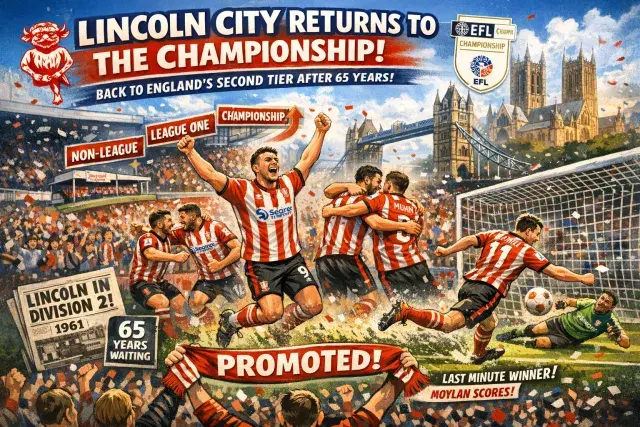
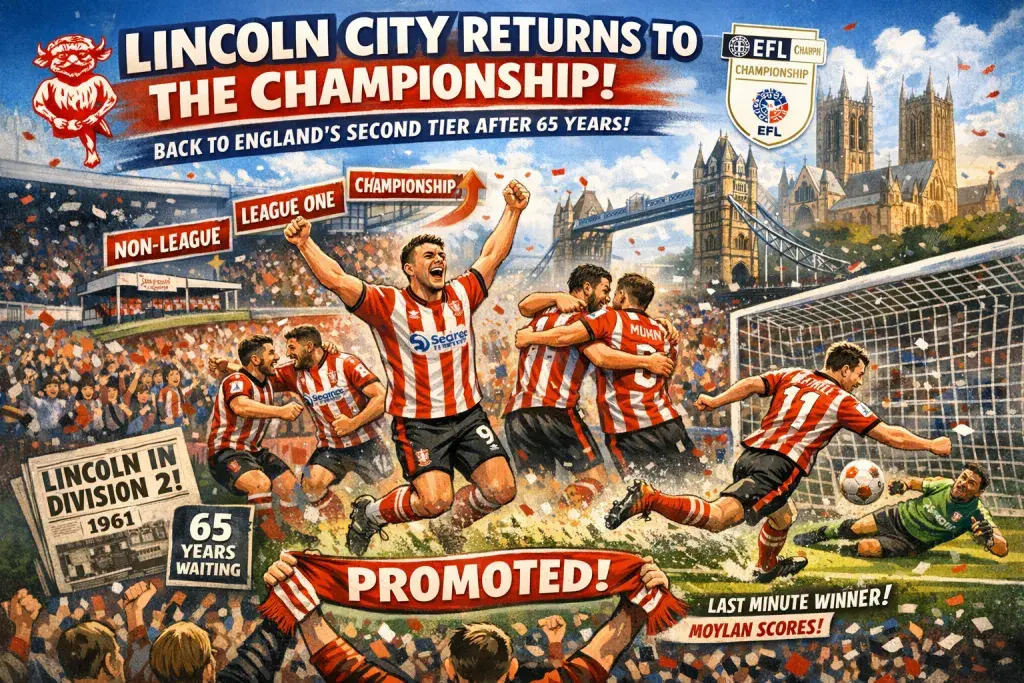
Lincoln City secured their place in the EFL Championship on April 7, ending a 65-year wait for second-tier English football that stretches back to 1961. The confirmation arrived via a 2-1 victory over Reading, completed in the sixth minute of added time, making Lincoln the first club in the English Football League to confirm promotion this season. With five fixtures still to play, the Imps now sit 12 points clear at the top of League One, a position that reflects one of the most consistent campaigns the division has seen in years.
A Journey Spanning Nine Years and Multiple Divisions
Context matters here. Lincoln City were competing in non-League football as recently as 2017. Their return to the Football League came in 2019, meaning the club has traversed multiple rungs of the English football pyramid within less than a decade. That kind of ascent is structurally rare. The English football system, with its promotion and relegation structure running from the Premier League down through several tiers to non-League competitions, is designed to reward sustained excellence — but it is also designed to test it. Clubs frequently rise and fall without consolidating, losing key personnel or financial stability along the way. Lincoln have, by contrast, built incrementally and held their ground at each level before pushing further.
The last time Lincoln played Championship football, the competition itself was structured differently. The second tier of English football in 1961 was known simply as the Second Division, and the current pyramid with its present naming conventions did not exist in its current form. Returning to that level now, under a head coach who has built the club's current identity around collective organisation and consistency, represents a genuine institutional achievement.
How the Confirmation Unfolded
Needing only a single point to confirm promotion, Lincoln took an early lead in the fifth minute through Ryan One, who headed home from a set-piece to silence a home crowd expecting a tighter contest. That advantage held through a first half in which Lincoln defended with clarity, offering little room for their opponents to build momentum. Reading pressed harder after the break and, deep in stoppage time, levelled through Lewis Wing's free-kick — a result that would still have been sufficient for Lincoln's purposes. Then, in the sixth minute of added time, Jack Moylan fired home from close range to restore the lead and settle the outcome.
The winning goal was not necessary for promotion, but it was consistent with a broader pattern this season. Lincoln recorded their 27th league victory of the campaign on the day, and extended an unbeaten run to 24 successive fixtures. Head coach Michael Skubala, speaking after the final whistle, described it as epitomising the entire season: "The lads have been excellent all season, and to get the job done today, to get promoted on Easter Monday, just epitomises our season." He added that the club's focus now shifts to winning the division outright: "We want to win the title. It's going to be tough, but let's go and get that done."
What Promotion to the Championship Means Institutionally
The EFL Championship is one of the most financially demanding second-tier divisions in European football. Clubs compete not only for points but for access to the Premier League — and the transformative broadcasting revenues that accompany it. That financial pressure has historically resulted in significant wage inflation, short-term recruitment strategies, and, in a number of well-documented cases, serious financial distress. Several clubs have entered administration after failing to sustain Championship-level expenditure following promotion, a phenomenon sometimes called the parachute payment imbalance, referring to the financial cushion that clubs relegated from the Premier League receive and which others do not.
For a club that was outside the Football League entirely less than a decade ago, navigating that environment will require careful institutional management alongside ambition. The Championship will bring increased revenue, larger attendances, and greater national visibility, but also a sharper competitive environment and higher operational costs. Lincoln's ability to plan for that transition — in recruitment, infrastructure, and financial structure — will determine whether this promotion marks a genuine new chapter or a brief excursion before a return journey.
With five fixtures remaining and a 12-point cushion at the top of the table, the immediate priority is the division title itself. Whether that symbolic completion materialises or not, Lincoln City's 2024–25 campaign already represents one of the more compelling stories of sustained, upward institutional progress in English football's lower divisions in recent memory.


