
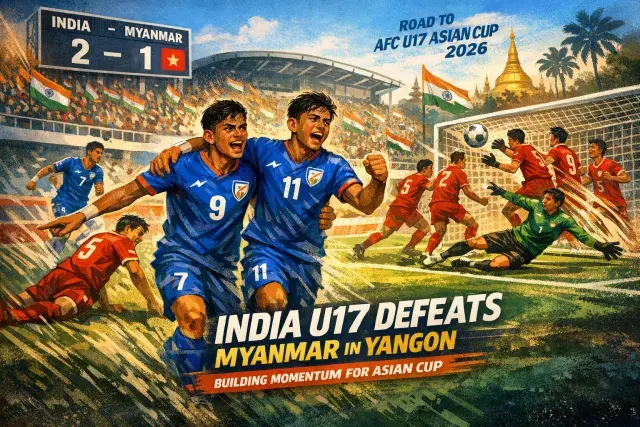
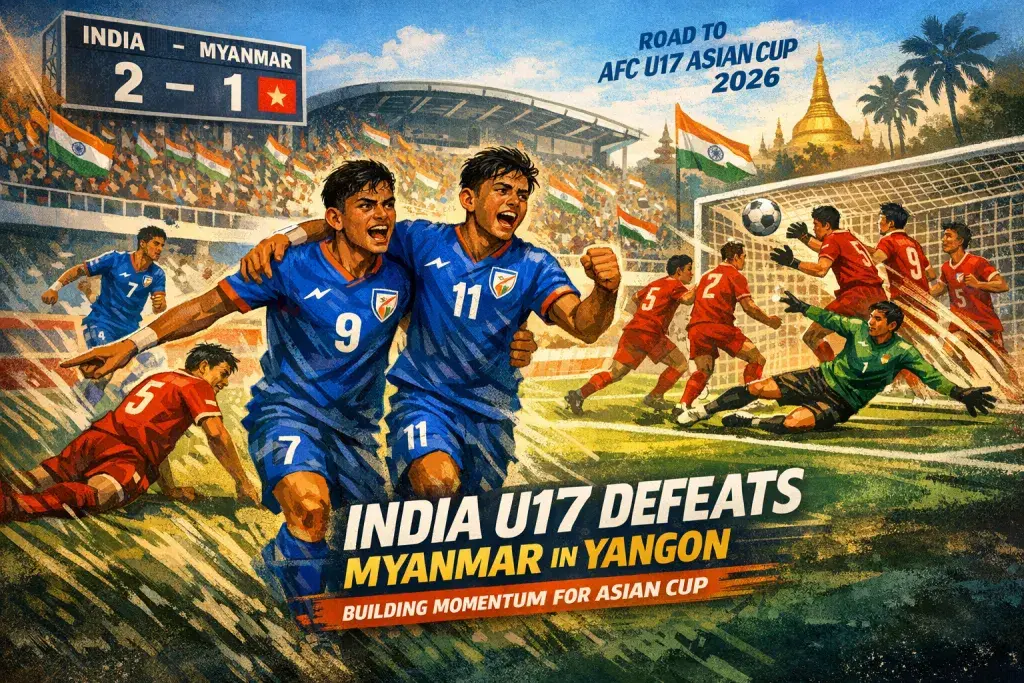
India's under-17 men's side claimed a 2-1 victory over Myanmar U17s at Thwunna Stadium in Yangon on Tuesday, their opening friendly in a preparatory campaign ahead of the AFC U17 Asian Cup Saudi Arabia 2026. Two first-half goals gave the visitors a commanding cushion that survived a second-half response from the hosts. The result marks India's first recorded win on Myanmar soil at this age level, according to the All India Football Federation.
How the Goals Were Built and Conceded
Both of India's goals arrived through the same tactical pattern: rapid vertical transitions exploiting space behind Myanmar's defensive line. Washington Singh Ngangom opened the account in the 11th minute after Gunleiba Wangkheirakpam drove down the left flank and cut the ball inside to the unmarked forward, who finished from close range. Thirteen minutes later, Gunleiba converted for himself, receiving a well-weighted through ball from captain Dallalmoun Gangte and finishing from a tight angle into the side-netting.
Myanmar reduced the deficit in the 54th minute through a set piece. Captain Ant Htoo Paing delivered a long-range free-kick into the Indian area, and Myint Myat Ko Ko directed a header past the goalkeeper. The goal shifted the second half's momentum but India's defensive organisation held under sustained pressure, preserving the one-goal advantage through to the final whistle.
What This Fixture Reveals About India's Developmental Approach
Friendly fixtures at youth level serve a precise function that differs substantially from senior international competition. Coaching staff use them not primarily to win but to evaluate positional combinations, test tactical frameworks under moderate competitive pressure, and identify players who can execute a defined system when conditions are unfamiliar. A result like Tuesday's — built on repeatable structural patterns rather than individual brilliance — gives technical staff useful evidence that a scheme is translating from training into practice.
India's use of the left wing as a primary avenue of progression, and the central role Gunleiba played in both goals, suggests the coaching unit has identified that corridor as a point of structural advantage against compact opposition. That specificity matters at this stage of preparation. With the AFC U17 Asian Cup still months away, the emphasis on building tactical habits and positional instinct is far more consequential than the result itself.
The Broader Significance of Youth Development in Indian Football
India's investment in age-group structures has deepened considerably over the past decade, shaped in part by the country's participation in the FIFA U17 World Cup in 2017, which was hosted on Indian soil. That exposure accelerated institutional interest in youth pathways, scouting infrastructure, and competition exposure for players who would otherwise have limited access to high-level environments before the senior tier.
The AFC U17 Asian Cup represents one of the most competitive youth platforms in continental football outside Europe and South America. Qualification and strong performance at that level carries tangible downstream consequences — increased visibility for players in domestic structures, better access to club academies, and a stronger pipeline into the senior national setup. Victories in preparatory fixtures like Tuesday's in Yangon contribute to the psychological and tactical readiness that under-17 groups need before entering that environment.
What Comes Next for the Blue Colts
Tuesday's fixture was described as the opening friendly of a series, implying further preparation windows remain before the AFC U17 Asian Cup. The nature of those future contests — opponents, venues, intensity — will shape how much of the tactical identity established in Yangon can be reinforced or revised. For a young group, consistency of selection and system across multiple fixtures carries more value than any individual result. The 2-1 win in Myanmar is a starting point, not a destination.


